Wednesday, 29 July 2020

India’s rapid connectivity strides in the neighbourhood

Repulsing the Chinese intimidation, India stood the ground and incontrovertibly reasserted its position to defend its sovereignty at all costs. Twice in the recent past, during Indo-China standoffs, China blinked first. Steamrolling China’s hegemonic aspirations, India dared to stare back at the Dragon. Cognizant of Sino-Pakistan collusivity, India is now gearing up for a two-front war. But the nefarious Dragon which has substantially expanded influence over the entire sub-continent is now opening several fronts to badger India. China sees India as an obstacle.  Its dogged pursuits to extend tentacles in the India’s neighbourhood has been integral part of China’s policy of encirclement of India.

India’s deep civilisational connect with its immediate neighbourhood and strong historical ties have been a matter of immense pride. Buttressing this age-old connect, India along with Bangladesh attempted to resurrect the regional cooperation through SAARC. But the perpetual disagreements and inimical animosity disgorged by Pakistan imposed roadblocks and derailed the objective of collective development. Since the turn of the century while China, steadily expanded its influence in India’s neighbourhood, New Delhi was caught napping.

Infusing new momentum into India’s civilisational and cultural connect, through the “Neighbourhood First” Policy, Modi attempted to strengthen the bridges of strategic partnership. Besides the soft power, in line with the developmental needs India turned key areas like connectivity, finance, education, capacity building, skilling and health care into arenas for cooperation. But unlike India’s soft developmental approach, China began to cultivate Indian neighbourhood for larger strategic gains. Nepal’s needling of India at Dragon’s behest and Prime Minister Oli’s brinkmanship; China’s growing economic cooperation with Bangladesh-$38 billion worth investments, tariff exemptions to 97% of Bangladesh exports, smart cities development, construction of permanent submarine base in Bangladesh’s Cox bazar; 99-lease of Sri Lanka’s Hambantota Port, Colombo Port construction, dredging and building construction spree in the Indian Ocean Island; China’s acquisition of Maldives Feydhoo Islands in lease till 2066 and infrastructure development in the Indian archipelago have only heightened the apprehensions of China’s burgeoning influence in India’s traditional sphere of influence.

Given China’s penchant for an indirect and insidious attacks against India, strategists expounded fears of Dragon using its leverage in the sub-continent to overwhelm India. Along the expected lines, to pressure India and coerce Bhutan, the only Indian neighbour which don’t have diplomatic ties with China, Dragon made fresh claims over Sakteng Wild Life Sanctuary situated in eastern Bhutan. Doubling down, its claims, China even tried to stall funding to Sakteng Sanctuary at Global Environmental Facility (GEF) virtual meeting. Bhutan rubbished these claims. With majority of GEF member countries including India supporting Bhutan, council rejected China’s objections. Fervently rejecting China’s claims Bhutan issued a strong demarche to China.

China’s fresh claims to the far-eastern Bhutan territory is part of 90,000 sq km territory of Arunachal Pradesh. Undercutting China’s nefarious strategies and shedding inertia, India made quikc tactical moves. Days after China’s new claims to the Sakteng Sanctury in the Trashigang district of Far East Bhutan home to mythical ‘Yetis’ and ‘Brokpas’, the semi-nomadic tribes, India has proposed to build a strategic road through the Yeti territory. The project assigned to BRO, passing through the Trashigang district connecting Guwahati to Tawang would not only reduce the distance by 150 km but would also favour quick deployment of troops 1.

Bhutan is a buffer state between India and China and highly significant for security of India. With China spreading its bloody tentacles in the region, in a major boost to connectivity, India and Bhutan have launched a new trade route which will operate between Jaigaon in West Bengal to Ahllay, Pasakha in Bhutan. India is Bhutan’s largest trading partner, opening of new road route will decongest existing connectivity links and facilitate quicker movement of goods. This development comes days after India’s Satluj Jal Vidyut Nigam entered into a concession agreement with Druk Green Power Corporation of Bhutan for the construction of 600 MW Kholongchhu Hydroelectric Project in Bhutan. Signing of this Joint Venture between India and Bhutan, the first of its kind between two countries will give a major fillip to the bilateral hydroelectric cooperation 2. 

In a bid to revive poor delivery record, India is also expediting expansion of Hanimaadhoo airport in Maldives. India pledged Line of Credit to President Solih on his first visit to India for connectivity project. The runway expansion and construction of new terminal building will play a major role in economic and tourism development of Northern Maldives3. India, earlier, extended funds for redevelopment of Jaffna airport to handle international flights paving way for commencement of Chennai to Jaffna commercial flight operations last year.

Giving a major boost to economic cooperation between India and Bangladesh, last Thursday, Minister of Shipping Mansukh Mandaviya, flagged-off a container ship carrying steel bars from Kolkata to Agartala through the Chattogram port of Bangladesh. This route besides reducing the time and logistics of cargo operation will open up new realms for using multi-modal connectivity between India and Bangladesh. During President Hasina’s 2019 visit to India, both sides have formalised the Standard Operating Procedures (SOPs) for the use of Chattogram and Mongla ports for transport of goods from mainland to India’s North East. The SOPs laid a framework for the movement of goods through waterways, road, and rail. In 2015, India and Bangladesh signed the coastal shipping agreement and transshipment of goods to and from Bangladesh in 2018. Eight routes have been identified under this multi-modal transport.

These include use of Chattogram/Mongla port to Agartala via Akhura, Chattogram/Mongla port to Dawki (Meghalaya) via Tambil, Chattogram/Mongla port to Sutarkandi (Assam) via Sheola, Chattogram/Mongla port to Srimantpur (Tripura) via Bibirbazar and viceversa 4. The recent trial run from Kolkata besides beating the economic vulnerabilities of the COVID-19 induced economic slowdown will create employment opportunities, integrate supply chains, promote business services and foster investments. Trade and connectivity have potential to alleviate poverty and ensure stability and India’s commendable initiative to spur growth in the sub-region through the connectivity projects will deepen trust and promote strengthening of long-term partnership between India and its neighbouring countries.

At a time when China extended several concessions to woo Bangladesh, stepping up the game, India instituted a multi-pronged strategy to enhance trade and business partnership. Unlike China’s investments and loans with incipient threat of debt-trap, India’s seamless connectivity will be a win-win situation scenario for both countries. Despite Mamata Banerjee’s objections to resumption of the cross-border trade with Bangladesh, government of India overturned her decision and restored land trade. Bangladesh is India’s biggest trade partner in South Asia. To promote trade and reduce the trade imbalances, India offered some tariff concessions. India has extended $8 billion Line of credit over the past eight years becoming the largest recipient of India’s concessional loans. India also extended financial assistance towards dredging of ports, rail route construction and funded 55 Small Development Projects (SDP). While India can’t match China’s deep pockets, it is actively involving in mutually beneficial partnership.

Also, in a first, Indian Railways ran a special parcel train to Benipole in Bangladesh from Reddipalem in Guntur district, Andhra Pradesh. Freight trains reduced the time of travel and transportation cost by five times. India and Bangladesh are now planning to revive the old rail routes that served as lifelines of Assam and East Bengal before 1970. Plan is afoot to connect the north eastern region with Bangladesh Rail line by 2021 and to run the first rail connection between Agartala and Akhaura in Bangladesh on the 75th Independence Day celebrations of India 5.

To infuse fresh momentum into India’s ties with the neighbourhood, India undertook a massive diplomat rejig exercise within the MEA. Seasoned diplomats JP Singh and Arindham Bagchi are now appointed as heads of the crucial Pakistan-Afghanistan-Iran division and Northern division (Nepal and Bhutan) 6.

At a press meet in Moscow, Mynamarese commander-in-chief Aung Hlaing called for international cooperation against terrorism and hinted at the role of a “strong force” in abetting terror in the country. Indian Defence Minister who was in Moscow to attend the Victory Parade used the opportunity to reach out to Gen Hlaing and explored the possibility of defence cooperation between two countries. Disclosing that foreign forces have been funding the designated terror organisations Arakan Army (AA) and Arakan Rohingya Salvation Army (ARSA), the general expressed their lack of trust in China which has been pressuring Myanmar to implement BRI projects. China has planned CMEC (China Myanmar Economic Corridor), along the lines of CPEC to gain access to Bay of Bengal. To implement BRI in Myanmar and protect its investments, China has been arming the AA 7.

Expectedly so, AA while threatening and abducting Indian contractors working on the Kaladan Multi-Modal Transit Transport project in the Rakhine state has been friendly towards the Chinese assets in Myanmar. Kaladan Project aims to connect Kolkata with Mizoram in the North East through Rakhine and Chin states is cornerstone of India’s Act East Policy. In the past few years, as a part of capacity building, India has been catering to Myanmar’s defence needs. In 2017, India supplied torpedoes, ‘Shyena’ under a $38 million export deal and handed over kilo class submarine refurbished by Hindustan Shipyard Limited (HSL), Visakhapatnam last year 8. Through “Operation Sunshine” co-opting Myanmar, India has successfully targeted the insurgent groups active in the North East region. In May, Myanmar has handed over 22 rebels with their bases in Sagaing region. India and Myanmar have been steadily buttressing defence cooperation. After calling the bluff of China and growing suspicious of Chinese intentions, Myanmar is now expediting India’s infrastructure projects. India which has developed the Sittwe port in Rakhine state under the Kaladan project has resumed operations in 2019. Myanmar is now levitating towards a democratic India which is benign unlike the Dragon.

Amid speculations of China holding its sway over Indian neighbourhood with its offer of help in combatting COVID-19, India has intensified its outreach. Recently India has concluded talks with Sri Lanka over the debt rescheduling, repayment and currency swap arrangements.

While the disengagement of India and China troops along the LAC is underway, alarmists have portrayed a gloomy and desolate picture of India under siege. Repudiating these apprehensions, espousing “together we grow” approach, India is assiduously fortifying the “Neighbourhood First Policy”.


@ Copyrights reserved.

Friday, 17 July 2020

China’s ensnarement of Nepal

Another day, another inconsequential remark, and the Nepali foreign Ministry goes into a damage control mode. This has become a new normal. Yet again, Prime Minister KP Sharma Oli’s remarks, “the place called Thori near Birgunj is the real Ayodhya, where Lord Ram was born. In India there is great dispute on Ayodhya. But there is no dispute in our Ayodhya” has sparked fresh controversy. Oli’s unrelenting anti-India tirade has sent the region into a tizzy.  His off the cuff remarks are creating fresh fissures in the tenuous Indo-Nepal bilateral ties.

Amid intraparty quibbling, protests over gross mishandling of the pandemic, mounting corruption charges, reluctant to renounce his high chair, Oli sensed an opportunity in India’s 80 km road to Lipulekh road to revive his political career. Losing no time, Oli raked up disagreements over the Kalapani region. Convening a joint parliamentary session, Oli rolled out a legislation to include three Indian territories Kalapani, Lipulekh and Limpiyadhura in the improvised political map of Nepal.  Stoking nationalist sentiments, Oli tried to avert the domestic attention from his incompetence when India is locked in a major stand-off with China across LAC. Timing in geopolitics is really crucial. With PLA troops at the border, battling a surging pandemic, India assured Nepal of foreign ministers talks to resolve the outstanding border issues. But Oli refused to relent. Soon the improvised Nepal political map with Indian territories after President’ authentication was incorporated with the Coat of arms. Oli’s extraordinary urgency to unilaterally change the territorial boundaries has only fuelled mistrust but failed to alleviate domestic political dissent.

Barring the only discordant note of Nepal acting at the “behest of someone” by Indian Army Chief, who is conferred the title of ‘honorary general of Nepal Army’ which ruffled some feathers, reminding Nepal of ‘roti-beti ka rishta’ and the “untenable” territorial assertions, India maintained strategic silence. Despite Oli’s barrage of invectives holding India responsible for the pandemic, mockery of India’s National Emblem, ‘Satyameva Jayate’ and accusations of Indian Embassy plotting to topple him, India refrained from responding.

Amid Oli’s ultranationalist posturing and strident anti-India attacks, opposition leaders pulled him up for China’s surreptitious encroachment of country’s northern territories. Maintaining deafening silence, Oli demurred. Ensconced by China’s omniscient puppeteering, Oli continued to fan nationalistic sentiments by spewing out venom against India. While China continued to actively reshape the domestic political dynamic of Nepal, strategic analysts harangued India’s Neighbourhood First Policy. They sneered at India’s travesty of failing to strengthen robust ties with the Himalayan country.  While there is some amount of merit in their observations, curiously Oli seemed to have ended up in the similar situation as many other leaders of the region.

Former Malaysian Prime Minister Najib Razak, Former Maldivian President Abdulla Yameen have something in common. These two disgraced leaders with dubious Chinese links are charged with embezzlement of funds and corruption respectively and jailed. Najib who set up 1 Malaysian Development Berhard (1MDB) in 2009 having siphoned state funds in a massive abuse of power, sought China’s help to bail him out from money laundering in return for investment deals. As the President of Maldives from 2013 to 2018, Yameen went out of the way to woo China. Besides joining BRI and signing FTA, he favoured Chinese investments and reportedly leased out islands to China under the ruse of tourism development. Voted out of power, Yameen is currently facing jail term for his scandalous deals. Even the legacy of the authoritarian Cambodian Prime Minister Hun Sen’s legacy is awash with corruption charges and replete with shady Chinese connections. Sen is known to have awarded numerous projects to China and received massive kickbacks in return. Cambodia, which is at the brink of turning into a neo-Chinese colony is among the list of the eight countries affected by predatory policies and debt trap diplomacy, hall mark of the BRI.

Analysts have been cautioning about Dragon’s modus operandi of penetrating the weak economies headed by corrupt leaders to foster its business interests. The political fall outs and ouster of the corrupt leaders from power in different countries affirm their prescient observations. So far, President Mahinda Rajapaksa, Prime Minister Najib Razak, President Abdulla Yameen have paid a hefty price for favouring Chinese investments. Scepticism towards Chinese investments is a reality and countries are clearly wary of China’s opaque deal making.

Given ideological moorings of Oli, Nepal’s drift towards China has been imminent. Oli hastened the levitation by signing trade and transit treaty with China in 2016.  By ratifying BRI in 2017, Oli legally opened flood gates for Chinese investments into the Himalayan realm. Under the guise of reducing over-dependence on India, Oli indulged in unprecedented patronage of China. Nepal is home to significant number of Tibetan refugees, with Oli rolling out a red carpet to Dragon, twin purposes of bolstering investments under the flagship BRI and coercing voices of the Tibetan voices in Nepal were effectively fulfilled. China accounted for 90% of total FDI to Nepal in the past four consecutive years 1 which is reflected in Dragon’s proportionate increase in Nepal’s domestic politics as well.  

Classic feature of BRI has been co-opting corrupt leaders of weak economies to surreptitiously penetrate the system. Roland Jacquard, reports in The Global Watch reported China’s machinations on the Himalayan country2. This explosive piece, traced Oli’s links with China since his first stint as Prime Minister Oli in 2015-16 when he assisted the then Chinese ambassador to Nepal, Wu Chuntai to invest in telecommunication sector in Nepal.

Brazenly violating the government regulations, Oli awarded contracts to Chinese companies or Nepali businessmen with close links to Prime Minister’s office. In 2018, Huawei bagged the project of setting up, “Digital Action Room” in Prime Minister’s office even when such technologies were indigenously available. In May 2019, Nepal awarded contract for developing radio access network and installing 4G network to China’s ZTE. Similarly, overturning former Prime Minister Sher Prasad Deuba’s decision, Oli granted the contract for $2.42 billion 1200 MW Budhigandhaki Hydropower project to Chinese state-owned company Gezhouba Group. In all these cases, Oli awarded the contracts, without competitive bidding to Nepali businessmen close to Oli who are reliably learnt to have received huge kickbacks from Chinese companies.

Even the threatening Corona pandemic failed to shake Oli’s loyalty towards China. Despite reports of over-priced China’s defective medical supplies, Oli routed all essential medical equipment imports from China’s OMNI group, which has close links to Prime Minister’s secretariat. In 2017 elections, OMNI has supplied defective printing machines to Nepal election commission. Demanding accounts for the Nepali Rs 10 billion spent to fight the COVID-19, Nepali youth are now protesting against Oli and growing Chinese interference in Kathmandu’s domestic affairs.

The Global Watch report has come as a final blow to Oli’s sinking public propriety and reputation. Stating that Oli’s personal finances has increased manifold in the recent years it disclosed details of Oli’s joint account with his wife Radhika Sakhya in Geneva Branch of Mirabaud Bank which is holding $ 5.5 million long term deposits and yielding yearly returns of half a million dollars. Disclosures made by Global watch sounded a death knell for Oli’s plummeting political career. The report busted China’s standard diplomatic bluff of– “non-interference in the domestic affairs of foreign countries” and debunked the touted “win-win” situation of BRI. BRI has been Dragon’s neo-imperialistic strategic tool designed to advance Chinese interests. Clearly, China’s ensnarement of Nepal is complete and irrevocable.

Even as Nepal’s foreign ministry is firefighting Oli’s irresponsible statement with clarification saying, “the remarks made by the Prime Minister are not linked to any political subject and have no intention to hurt the feeling and sentiment of anyone. As there have been several myths and references about Shri Ram and the places associated with him, the Prime Minister was simply highlighting the importance of further studies and research of the vast cultural geography the Ramayana represents to obtain facts about Shri Ram, Ramayana and the various places linked to this rich civilisation. The remarks are not meant to debase the significance of Ayodhya and the cultural value it bears3. While Oli’s remarks caused wide-spread public consternation in India, New Delhi resisted the temptation of bristling at his repeated anti-India jibes.

Nepal is victim of Chinese Communist Party’s (CCP) encroachment and Oli’s anti-India tirades are a manifestation of the Dragon’s ensnarement, hell-bent on damaging the India-Nepal ties beyond repair. India is closely monitoring China’s tightening vise-like grip on Nepal and its nefarious tactics of using Kathmandu as launch pad to attack New Delhi.


@ Copyrights reserved.

Friday, 10 July 2020

Book Review: Meenakshi Jain's Flight of Deities and Rebirth of Temples

Temples have been bedrocks of the flourishing Indian civilisation. Any attack on temple is a collective assault on the people associated with the faith. Undermining the intent and iconoclastic zeal of the Muslim invaders and their explicit hatred towards idols and idol worship advocated by Quranic injunctions, the intellectual brigade of India has perversely defended ruthless marauding by perpetuating the myth of this practice of desecration of temples being carried out Hindu rulers. To defend the iconoclasm, apologists drew mischievously drew parallels with the practice of appropriation of idols by Hindu rulers in times of conflict.

Padma Sri Meenakshi Jain an authority on the Indian history chronicled the attacks on Hindu, Jain and Buddhist temples in the Indian sub-continent for over centuries by the invading Muslim marauders in her work, “Flight of Deities and Rebirth of Temples: Episodes from Indian History”. Considered as a sequel to “Sitaram Goel’s Hindu Temples: What happened to them?”  and her earlier work on Ayodhya, by Indologists, Jain’s work offers the most comprehensive analysis of temple destruction in Medieval India.  This quintessential go-to source on the loot and plunder of the temples is no less than an encyclopaedia, for it backs every assertion with referenced studies and primary sources. The book besides discrediting the fallacious arguments of the Left shatters the mythical theories propounded by them. In tune with the popular adage, “History is written by victors” which implies that history is not grounded in facts but always interpreted by the winners to suit their perspective the Leftist historians tactfully distorting the facts and birthed a new narrative which was dutifully fed for academic and public consumption.

Repudiating the fallacies of the Leftist historians, Jain put appropriation of murtis by Hindu rulers in perspective by recalling a verse in the Purva Karana Agama which essentially prods the triumphant King to bring deities from defeated king and arrange for worship. It is supposed to serve two purposes-divest the ruler of the Divine protection and ensured that idols/ murtis remained under veneration.

By characteristically portraying the temples destruction as “a lust for plunder”, apologists whitewashed the motivated attacks of plunderers like Muhammed Ghaznavi, who revelled in the appellation of Muhamad bhutshikan, “Mahumad the breaker of idols”.

Yet the Leftists discredited the theology alluding to a theory of temples as centres of resistance had to be extricated for consolidation of authority. For over decades, this charade has been deeply instilled into the minds of unsuspecting Indians by churning out tonnes of literature to perpetuate the fakery. New hypotheses are constantly invented to simply pass off the desecration of temples and building of mosques over them as “a productive engagement with local traditions of temple architecture”. Without even sparing a thought about the sacredness, faith, the civilisational continuum of these divine spaces and emotional trauma inflicted on the millions by the destruction of the temples, scholarly articles perpetuated a vicious narrative. Conspicuously exonerating the plunderers of their malicious intent and their theological motivations, the apologists not only vindicated the vandalism, but failed to provide reprieve to the oldest civilisation which endured a barrage of attacks and invasions.

A one-sided interpretation of the facts has nearly wiped out the dogged pursuits of the santanis, who played with their lives to rescue, protect the murtis from marauders and ferret out idols of temples for safe keeping; the iconoclastic zeal of the Muslims and the resilience of various sections of Hindu society, who valiantly fought back to preserve their faith Jain gives an account of the wanton destruction in exacting detail and also brilliantly highlights the indefatigable efforts of rulers and Hindu community to resurrect temples. Spanning the sixteen chapters of the book are the devastating accounts of the barbaric attacks made on the glorious temples across the length and breadth of Bharatvarsha. It also encapsulates the unwavering faith of the santanis and active role played by the faith leaders who undertook adventurous expeditions and travelled miles along treacherous terrains, thick forests to save the murtis from falling into the hands of Sultans.

Barely years after the death of Prophet Mohammed Arab invaders began to strike at the Indian subcontinent. Upper Sindh region dominated by Hindu Rulers offered stiff resistance to the unceasing attacks of the Arabs. Finally, in 711 CE, Muhammed Bin Qasim established his firm hold on the Multan. In the conquest, the invaders destroyed the Sun Temple at Multan, the pride and glory of the people and reduced it to rubble. But by 1130 CE, Hindus reconstructed the temple and began worshipping the deity with undiminished enthusiasm and faith.

Soon Kashmir, the principal seat of Indian civilisation which is described as a place, “where there is not a space as large as a grain of sesamum without a tirtha” by Kalhana in Rajatarangini, was denuded and destroyed by the marauders. Sultan Sikander who earned the epithet of Butshikan, demolished, pulled down and desecrated and finally destroyed the temples by setting fire to the heaps of timber in the temples. Consequently, North India subjected to a torrent of invasions was bereft of notable tirthas. Delhi endured similar fate. Destroying Hindu and Jain temples, the invaders constructed mosques using the temple materials from pre-existing temples. Despite calamitous attacks on temples, in places of immense religious significance like Mathura, Brij, Brindavan, devotees refused to forsake the deities. Notwithstanding the attacks, Hindus would make concerted efforts to rebuild the temples though much less in grandeur but would fully restore ritualistic worship and observe religious customs discreetly.

Relentless attacks of maraduders failed to dampen the faith and belief of santanis, who at the whiff of an impending attacks removed murthis from temple precincts to avoid defilement. Often smaller murtis are ferried away in saddle bags to safer places. One such interesting detail of the migration of Sri Srinathji has been vividly presented in the book. Following Aurangzeb’s royal decree to raze every temple in Mathura to ground in 1669, murtis of Govinddeva were removed from temple. One image was concealed in Agra and hurriedly reinstalled in a house of a devotee. But the deity soon left for Kota and as per directions of the ruler, moved to Kishangarh, Chaupsani on Jodhpur border. After the King of Mewar deputed one lakh Rajputs for its protection, Gosains set out on their journey with the murti to Udaipur, 40 km north of the Udaipur, the bullock cart carrying the murti got stuck. Believing it to be the divine wish, a temple was soon constructed and the murti was installed in the temple on 10th Feb 1672 at Nathdwara. After nearly two years the murti was consecrated. Often times, murtis have been on a move for decades, till a propitious occasion for their reinstatement could take place.

Incidentally of the nine navnidhis relocated from Braj, four navnidhis- Sri Nathji, Sri Navanit Priya, Sri Vittalnath and Sri Dwarakanth found shelter in Mewar. Three of them- Sri Gokulnath, Sri Gokulchandrama and Sri Madanmohan settled in Jaipur, Sri Mathuresh was moved to Kota and Sri Balakrishna to Surat. Despite the threat of the Muslim sword hovering over their heads, sanatanis risked their lives to save deities. Flight of navanidhis is just one of the shining examples of the exalted attempts and heroic resistance displayed by Hindus.

While some attempts to save murthis have been successful, it would often take years, decades and centuries to retrieve and safely reinstall the murtis in temples. Many times, the murtis are lost forever. Notably all the events of desecration have been handiwork of the invaders, emperors or sultans with no involvement of political circles. 

Nearly every nook and corner of the Medieval India bore the brunt of the barbaric attacks of Muslim invaders. Due to fear of Aurangzeb’s iconoclastic zeal, officiating priests of temples- Varadaraja, Ekamresvara and Kamakshi Amman were quietly removed from temples and after the danger subsided, the murthis were brought back. In this case after 22 years, murthis returned to temples. Similarly, for over thirty years idols of Sri Jagannath were absent from Puri. Sometimes, the murthis are buried in sand to protect them from sacrilege.  

Several Hindu rulers generously donated lands and funds to rebuild the demolished temples. Sri Krishnadevaraya of Vijayanagara Empire, The Marathas, The Gahadalvas, The Rajputs stood forth as “Champions of Hinduism” and played a phenomenal role in rebuilding of temples and preserving the dharma of the land.

Even Portuguese invaders, unleashed a wave of destruction and divested the hallowed land of Gomantak or Goa of its sacred heritage. Described as the land of Parashurama, temples in 58 of the 76 villages were completely destroyed and churches were built in their place.

For all the dubious virtuosity heaped on the undeserving Mughals, almost no temples were allowed to exist in Mughal palace towns throughout their rule. The high-ranking Hindu officials used to obtain a special permission to build small temple in their private spaces surrounded by high rise walls. None of the temples had the hallmark Shikara and remained hidden while the visible mosques dominated the landscape. Hardly any temples were built during the Muslim reign. After the rise of British colonialism, new temples were built. But unfortunately, even after independence, the spate of Hindu civilisation which has endured severe suppression found no hopes of revival. With government tightening its hold and control over the temples, depriving them of necessary fund to maintain and run them, the travails of the santana dharma in its land of origin seems to be unending. The criminal neglect and apathy of the Archaeological Society of India and thriving idol smuggling gangs have only alleviated the ordeals faced by Hindu civilisation.

By systematically obliterating tales of heroic resistance of Hindus from the academic discussions, Leftists have denied the younger generation an opportunity to appreciate and venerate our ancestors who made supreme sacrifices to preserve the identity and traditional heritage of the land. Through unbiased interpretation of the events by painstakingly putting all the facts together, Meenakshi Jain has presented a cogent and coherent picture of the Medieval India. Her invaluable contribution towards understanding the resilience of Hindus and their unwavering faith in dharma will serve as guide for us and the younger generations as well. This outstanding compilation will go a long way in inspiring the deracinated Hindus who wallow in defeatist attitude. The book is more relevant than ever to stir the latent Hindu conscious which till date fails to appreciate the trials and tribulations faced by our revered ancestors to protect, safeguard and preserve the culture for posterity. This absolute must-read should be part of everyone’s personal library.


@ Copyrights reserved.

Saturday, 4 July 2020

Modi redefines strategic contours of engagement with China

Galwan Valley Incident is a watershed moment in more than one way. This violent confrontation has changed the strategic contours of the Indo-Chinese relations prompting India to recalibrate its Chinese policy which is jingoistically labelled as an appeasement policy by many noted strategists. In the aftermath of the recent India-China standoff at Eastern Ladakh, Chinese observers tore into India’s Chinese foreign policy and lamented the lack of resolve on the part of New Delhi to handle the annual military adventurism of China. Prime Minister Modi’s assurances and unambiguous statement to safeguard the territorial sovereignty subject to liberal doses of dissection became butt of contradictions forcing the PMO office to come up with a clarification. India’s actions remarked as too little too late and incongruent were belittled.

Unlike in other countries where a bipartisan agreement is reached over issues of national security, in the wake of the LAC standoff, there has been a concerted effort to give more traction to the Chinese apologists, and the left-leaning opposition. The negative clamour of #surrendertochina was amplified several-fold at the behest of undermining neatly chartered India’s foreign policy which is finding resonance with growing global anti-Chinese sentiments since the outbreak of the pandemic. Spearheading the regional leadership against the pandemic, India has steadily expanded the scope of cooperation by actively collaborating with the QUAD plus grouping, G20, NAM, revved up cooperation with middle-income countries and elevated ties with Australia to “Comprehensive Strategic Partnership”.

Notwithstanding the predicament of handling the virus and its originator both at the same time, India refused to be cowed down by hegemonistic ambitions signed a petition seeking an international investigation into the pandemic, allowed two MPs to virtually participate in the oath taking ceremony of Taiwanese President Tsai Ing-Wen and tacitly backed WHO membership to Taiwan. While skirmishes at LAC has been a common event, the newly appointed Chief Western Theatre Command, Zhou Zongqi, handpicked by President Xi raked up hostilities. Exploiting fault lines of previous agreements, Zhou approved a barbaric attack on Indian troops at Galwan Valley on June 15th, President Xi’s birthday as a token of his loyalty. By obfuscating the terms of agreement, China unilaterally changed terms of engagement and irrevocably broke the trust of India.

As a responsible country, employing the mutually agreed options of quiet diplomacy through Commander level talks India attempted to de-escalate situation. But China continued to aver, in contravention to agreed terms, China amassed forces and laid fresh claims to Galwan valley. Notwithstanding India’s demand for restoration of status quo ante, China dug their heels. Soon, the oft-repeated myth of India has limited options against China as it lags behind in military and financial heft began to gain ground with influential strategists rallying this anomalous analysis 1.

Economic Measures

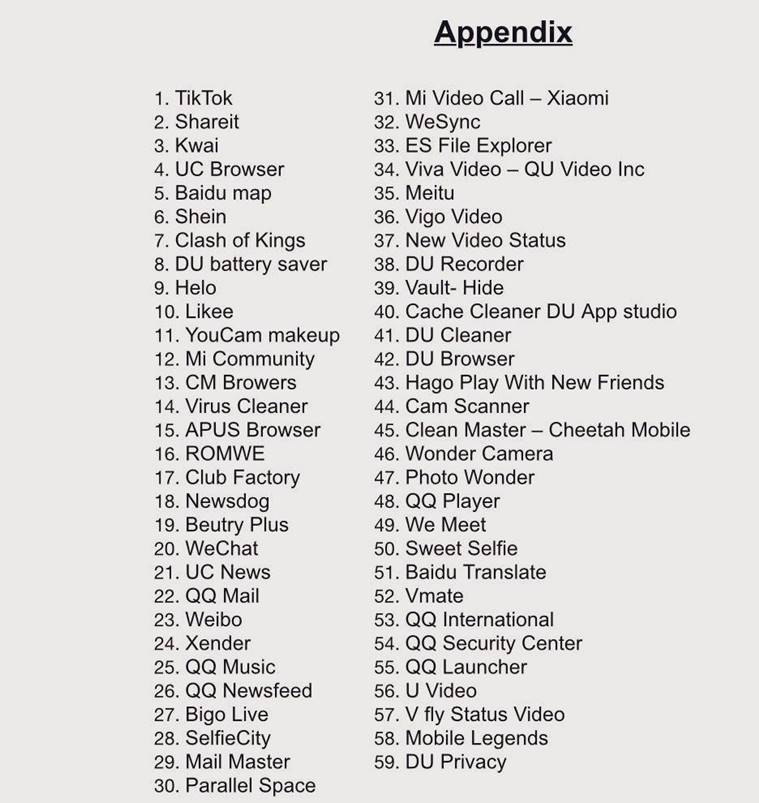
Abandoning the hedging posturing, India unleashed a slew of economic, diplomatic and military measures against China. Post Galwan incident, “boycott Chinese products” has become a war cry. Without tacitly endorsing the popular sentiment, fire walling Chinese FDI, India blocked 59 Chinese apps, the appendages of CCP. As per China’s National Intelligence Law legally obligates the Chinese companies to share data and intelligence. Religiously sticking to CCP dictums, Chinese apps have been stealthily transferring user data to servers in China. By banning the Chinese apps with over 300 million users, India thwarted China’s psychological warfare, hit Digital Silk Route ambitions, irrevocably tarnished its global reputation and facilitated the proliferation of indigenous apps. Following the suit, the US designated Huawei and ZTE as “national security threats”. While tangible economic losses aren’t immediately apparent, TikTok alone is estimated to earn revenue of Rs 2.5 Crore per day in India2. Though Global Times, vehemently denies any economic losses, reports portray a bleak picture.

Desisting use of trade sanctions as a strategic weapon, Telecom ministry banned all Chinese equipment, Ministry of Railways cancelled signal deal worth Rs 471 Crores. Upping ante against China, Ministry of Road transport and highways decided to disallow Chinese investments in MSME, participation in Indian Highway projects including through the route of joint venture. Placing Pakistan and China in Prior-Reference countries list, Ministry of Power pronounced ban on power equipment imports from China 3. Several state governments cancelled Chinese projects after Galwan clashes.

Diplomatic Measures

Expansionist moves of China nudged India closer to the US and brought democratic nations together. As a display of support, the US announced pulling of troops from Germany to Indo-Pacific. Dismayed by China’s aggressive posturing the US stationed three aircraft carriers in the region. Additionally, under the National Defence Authorisation Act (NDAA) 2021, US promised to offer fighter jet training detachment to India, Japan and Australia from October 6. With India, already elevating ties with Australia, its inclusion in the annual MALABAR exercises might eventually strengthen the QUAD and provide it a military angle. A development which China dreaded. Japanese Defense Minister, Tano Karo warning China of its military ambitions announced deepening of intelligence sharing with India, Australia and the UK.

Instead of lying low, India gave a bloody nose to China at Galwan. While India and China are still engaged in de-escalation talks, countries condoled death of Indian soldiers and the US, France, Italy, Australia, the Maldives, Germany, Brazil and Japan expressed support to India. President of Tibetan government in exile Lobsang Sangay condemned the death of Indian soldiers and slammed China. France, strategic partner of India offered to support India’s armed forces, promised to first batch of four combat ready Rafale jets by July end.  

27 nations have opposed China’s National Security Law for Hongkong. India which was initially silent raked up the issue at the UNHRC, expressed its concerns. An international group of thinktanks from 35 nations and territories openly condemned China for throttling Hongkong’s autonomy. At the UNSC, Pakistan attempted to pin the blame of attack on Karachi stock exchange on India backed by China. Germany and the US stalled the resolution.

Shedding the inertia, abandoning hedging posturing, India radically reorienting its China policy. Galwan, is the last straw that broke the camel’s back. Motivated by India’s confrontational approach, perhaps, Myanmar spilled beans on Chinese nefarious scheme of arming the Arakan Army, a designated terror organisation to protect its investments in the country. While Japan’s Liberal Democratic Party (LDP) urged government to cancel President Xi’s visit over Hongkong new security law. China is now cornered globally. China’s hegemonistic expansionism has compounded resentment of countries grappling with the Chinese Corona virus.

Military Measures

Gearing for a long haul at the LAC, Indian government granted financial powers to the three services to buy new inventory under emergency requirement procedure for up to 500 Crore. India beefed up security across the 3488Km LAC divided into three sectors.  To ensure supply of spare parts and fighter jets amid rising tensions, Defence Minister Rajnath Singh dashed to Russia. Bolstering India’s defence, Defence council approved the emergency purchase of 21 MiG-29s and 12 Sukhoi SU-MKIs and upgrades to 59 MiG-29s 4. Getting ready for Contigency-III, a collusive threat from China and Pakistan, India has increased the vigil across LAC and LoC following reports of Pakistan rushing 20,000 troops to Gilgit-Baltistan region to assist PLA. India moved 30,000 soldiers, artillery and mechanised infantry to fortify the Ladakh sector of LAC5. Despite Chinese pressure, Russia has agreed to speedup delivery of S-400 batteries by a year, three will be deployed along LoC and two across LAC.

After pushing the economic and diplomatic levers and ensuring a robust battle preparedness to galvanise the morale of the Indian forces, Prime Minister Modi, accompanied by Chief of Armed Staff Bipin Rawat and Army Chief MM Naravane visited the battle front. Unlike the US Presidents, the culture of leader of the country visiting forward posts to enthuse troops has been alien to India. US President is Supreme Commander of Armed Forces. But Prime Minister of India is merely a people’s representative and hence Modi’s visitations signify indirect affirmation of Peoples support to the Armed Forces.

 Applauding the sacrifices, and supreme valour of Indian Army, Modi paid rich tributes to the fallen soldiers and invoked the spirit of Veer Bhogya Vasundhara, “Veer safeguard their motherland with weapons. This is land of valorous. Our determination to ensure safety and security is as high as Himalayas” and Saint Tiruvalluvar’s exhortation- “valour, respect, chivalry and loyalty are the true hall marks of any Army”. Indian Army has always upheld these values. Without naming China, Modi said, “The era of expansionism is over. This is the era of development. A nation besieged by expansionist motives has always been a threat to World peace. History is witness to the fact that such expansionist forces were either defeated or forced to retreat”. Modi asserted that bravery is prerequisite for peace and weak can’t initiate peace indicating that India is still open for dialogue. But negotiation and dialogue shouldn’t be construed as weakness 6.

Reflecting on the virtuosity and civilisational values of the land, Modi said, we are the people who idolise and worship a flute playing Krishna and Krishna who wields Sudharshan. This message is to drive home the fact that India would honour friendship and cooperation but wouldn’t shy away from conflict if the situation demands. With his implicit messaging of India’s refusal to cower down, having prioritised procurement of weapons and fast tracking of infrastructure development in the border regions, Modi went full throttle with no holds barred approach.

For the past two months vested interests have been discrediting Indian government’s actions imputing political motives. Since his ascension to power, Modi has invested diplomatic capital in China’s policy. But China’s lack of reciprocity, dogged attempts to thwart India’s global aspirations and unceasing military adventurism has now reached a definitive moment. While most of the World is finding it hard to stand up China, Modi has dared to confront China. Stakes are really high. But Modi has resolved to recast his China policy.


@ Copyrights reserved.

Tuesday, 30 June 2020

India’s Digital Strike on China

Driving the Middle Kingdom towards its centennial objective of World domination by 2049, President Xi Jinping, ruler for life-time and head of everything has ambitiously embarked on misguided madness of territorial expansionism. Capitalizing on the “period of strategic opportunity”, China has been recklessly needling neighbours with its expansionist pursuits. Aggressive Chinese intrusions across LAC since 2014 have only epitomized China’s resurgent revisionism which received new lease of life under President Xi.

Guided by Chinese exceptionalism, Middle Kingdom is ruthlessly infringing international laws and norms. Flaunting its global rise, China tried to woo countries into its predatory initiatives like BRI. India not only refused to be part of China’s touted “win-win policy” of BRI but flagged concerns over violation of its sovereignty and repelled Chinese attempts to unilaterally alter the geography of the Dolam tri-junction. Beijing hasn’t taken India’s approach to stand up to Dragon kindly. Compounding this renewed assertiveness India withdrew special status to J&K and fortified its sovereignty. With Delhi lacking the appetite for imposing strategic costs, since 1980s China has been nibbling into the mountainous terrain of Indo-Tibetan border. Confronted by a strong-willed India, in the wake of the pandemic, China reared to bring India to bring to its knees with its military adventurism.

With twin ambitions of sending a strategic message to the East Asian countries, anticipating Indian capitulation, China escalated tensions along the LAC, intruding at multiple locations simultaneously. But to China’s dismay, India quelled the intrusions and gave diplomacy a chance. After marathon meetings on June 5th, commanders of India and China agreed on disengagement of troops. Disregarding the agreement, China not only amassed troops but indulged in its characteristic incorrigible behaviour. This eventually led to an inevitable violent confrontation for the first time in over four decades- the Galwan Valley incident, which led to the death of 20 Indian soldiers and undisclosed number of PLA troops. Barbaric killing of India personnel has become a reckoning moment for India. With China’s irrational behaviour staring in the face, India has insisted on gradual and verifiable disengagement.

Galwan incident triggered immense backlash against China in India. Local traders’ body-Confederation of All India Traders (CAIT) intensified calls of boycott of Chinese goods and to go, ‘vocal for local’. They released of list of 500 Chinese goods which can swapped with indigenous products1. Indian Railways terminated signal contract worth Rs 471 to a Chinese firm2, state governments (Haryana, Uttarakhand, Uttar Pradesh, Maharashtra) and PSUs ended Chinese contracts3. Earlier, India has tightened FDI investments from neighbouring countries, blocking Chinese takeovers and safeguarding its strategic industries.

Savouring the bloating trade deficits in favour of China in the Indo-China bilateral trade, Beijing has turned India into a dump yard for cheap Chinese products while binging on the perks of accessing huge Indian markets. India is not among the top 10 trading partners of China (as of 2018). Chinese exports to India are 3.1% of its total exports, India exports to China are 5.8% of its total exports. While Chinese imports account for 15% of our total imports. Clearly, India’s sanctions on trade will barely inflict any damage to China4 whose economy is nearly four times of India. India’s attempts to use trade as leverage would be counterintuitive. Despite growing clamour for boycott of Chinese goods, Indian government refrained from trade sanctions for the fear of exacerbating pandemic-inflicted economic crisis. Even Chinese mouth piece “The Global Times” mocked at India about the futility of trade sanctions8.

Instead India upped its ante. Debunking China’s preposterous fresh sovereignty claims over Galwan valley and attempts to put onus of easing tensions on India, Vikram Misri, Indian ambassador to China warned, “there should be a realisation on the Chinese side that there is no gain in trying to alter the status quo on the ground especially by resorting to force…that will not just damage the peace and tranquillity that existed on the border but it can have ripples and repercussions in the broader bilateral relationship”. India’s sharp rebuttals without imposing costs for China’s military adventurism and preference to diplomacy as a tool hardly perturbed China.

Prime Minister who has been unforgiving about China’s violent confrontations, in his monthly outreach Mann Ki Baat said, “those who cast an evil eye on Indian soil in Ladakh have got a befitting response. India honours the spirit of friendship…she is also capable of giving an appropriate response to any adversary without shying away. Our brave soldiers have proven that they will not let anyone cast an evil eye on the glory of Mother India5. Much to the disappointment of the populace, instead of openly endorsing the, ‘Boycott Chinese Goods’ campaign, Modi resolutely promoted "Atma Nirbhar Bharat" initiative.

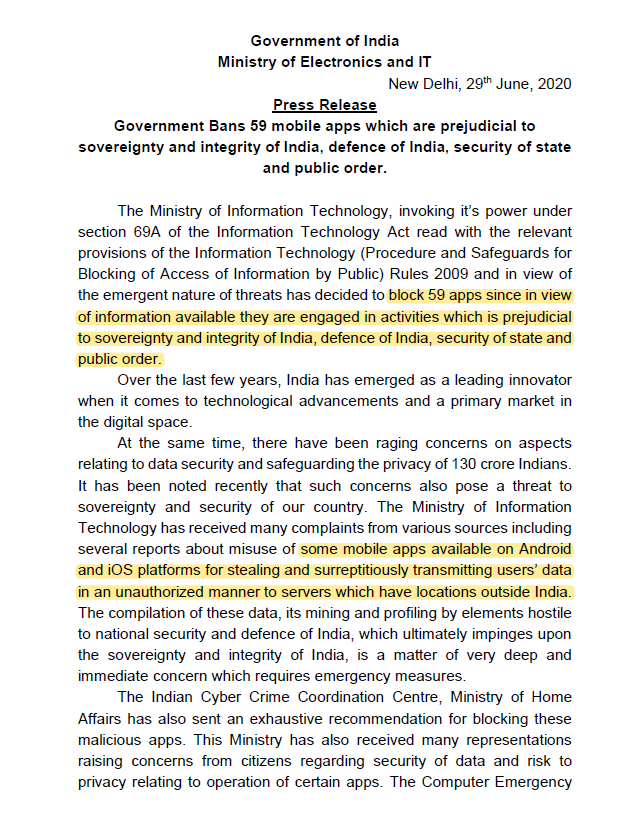
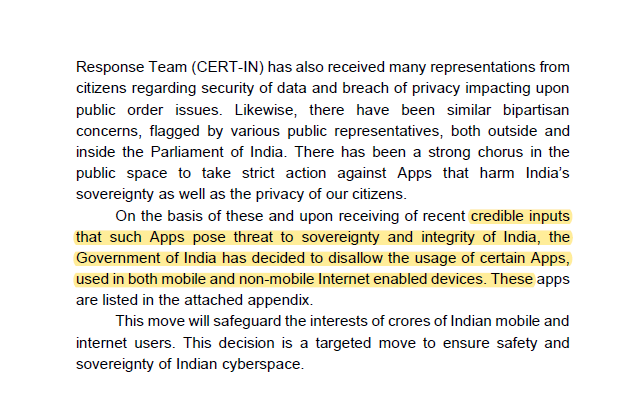
Without giving any inkling about the kind of retaliation, the government determined to extract retaliation announced ban on 59 Chinese apps. Ministry of Electronics and IT under section 69A of IT Act India blocked Chinese apps for “engaging in activities which is prejudicial to sovereignty and integrity of India, security and public order”. In 2018 Australian Defence Department raising concerns over espionage activities of Chinese apps banned staff and personnel from using WeChat 6. Recently US Republican Senators Josh Hawley and Rick Scott introduced a bill to ban TikTok for users using government devices 7. India’s move is bound to echo the popular global sentiment pertaining to Chinese apps which are extensions of Chinese Communist Party (CCP) and tasked with surveillance, spying and collection of data of private individuals.

China has been silently using these insidious technological conduits to steal data, transmit the user information surreptitiously to servers located outside India. These apps penetrate Indian system, spread fake news, censor anti-China content and insinuate people to violence. While China has firmly insulated its domestic audience from foreign apps, Chinese apps have been making a killing by gaining access to India’s 130 crores population. Under the larger strategy of Digital Silk Route-China apps with their easy to use interface, simple registration, alluring features and requirement of low bandwidth are becoming immensely popular among the tech savvy generation of India. By stealthy collecting user details, China is indulging in data mining and profiling. Psychological warfare through robust media technologies have been a forte of China. Since 2003, this information warfare has become part of China’s military doctrine. With burgeoning digital penetration in India, China is aiming to advance its propaganda war and espionage activities through these innocuous entertainment apps.

China is investing heavily in gaming technology and apps, besides strengthening the military might to penetrate democratic countries exploring the inherent fault lines and attempting to weaken them from within. Infamous for violating rules and set guidelines, authoritarian regimes like China are beyond the precincts of accountability. These regimes neither abide by the rules of regular play book nor do they respect extradition laws. Dubious tech companies of these countries can’t be held culpable for fiddling with national security. Indian Intelligence agencies have been warning of the threats posed by Chinese apps.

Presciently, given the widening economic parity between India and China, India can’t bargain for favourable outcomes with China exercising trade sanctions. With its digital strike, India has apparently conveyed its message. For decades, India has been reluctant to impose any costs on China. India failed to explore the inherent strengths of asymmetric options relying entirely on diplomacy to clear hurdles. China perceives diplomacy and negotiation as weakness. The resplendent Wuhan and Mamallapuram informal summits, failed to temper the irrationality of Beijing. China respects strength. By rejecting the digital avatar of BRI and refusing capitulation, India has asserted itself. Going ahead, India must guard its digital infrastructure from Chinese attacks and outrightly deny any space for 5G networks of China.

Setting a new precedent for Naya Bharat, India avenged Pakistan’s deplorable terror blitzkrieg with audacious cross border surgical strikes. China is not Pakistan. Disparaging China’s push over and military adventurism, India blocked free run of China’s spyware tools.


Sunday, 28 June 2020

PV Narasimha Rao: The man, who failed to receive his due

Iconised as, “India’s best Congress Prime Minister”, Pamulaparti Venkata Narasimha Rao, fondly called PV, born as June 28th 1921 in Vangara village of Karimnagar district of Telangana, is the first Telugu Prime Minister of India. Fondly remembered as the architect of the modern economic reforms that transformed the country and ended the Nehruvian socialism, his legacy is still debated. Torn between the disagreements of right and left, blamed for Capitalism and Communalism by the Marxists, his illustrious contributions which were largely undermined are now explored and deeply analysed. The new waves of revivalism that changed the ideological contours of India in 2014 had indeed augured a new enthusiasm among the hagiographers who are trying to resurrect his legacy.

Having spent his childhood in a region which is touched by several linguistic cultures-Telugu, Hindi, Marathi, Kannada, Oriya, Urdu and Persian he naturally picked up these languages.. Polyglot PV knew 17 languages. He served as chairman of Telugu academy and translated, Kavi Samraat Vishwanath Satyanarayana’s popular work Veyipadagalu into Hindi Saharaphan. He also translated Hari Narayan Apte’s Marathi novel Pan Lakshat Kon Gheto into Telugu.

PV’s tryst with freedom movement began when he was 17. PV along with 300 students participated in 1938 Satyagraha, sang “Vandemataram” banned by the Nizam and faced expulsion from the college. With help of some nationalists, PV obtained admission in Fergusson College, Pune and completed Master’s Degree in Law. Though he read works of VD Savarkar, subscribed to Communist Weekly New Age. But he got attracted to the national movement. While India became independent in 1947, PV actively worked under Swami Ramananda Tirtha for the liberation of the Princely state of Hyderabad. Ramananda Tirtha has been a formidable influence on PV. After the successful annexation of Hyderabad, PV chose politics as his career. Around the same time Indian National Congress has also transformed as a political party.

Since 1948 PV steadily carved a niche for himself in the Congress party which has been a sea of contradictions, cultivating relations with different factions within the party, he shone as a “ajathashatru” (someone whose enemies are yet to be born). PV contested in first Loksabha elections as Congress representative from Huzurabagh constituency and lost his elections against Communist party candidate. Later in 1957 he contested for assembly elections and won from Manthani. For the next twenty years he never lost elections. In 1964 he became state minister and handled several portfolios till 1971.

To quell a booming agitation by landless farmers in the Telangana region, Prime Minister Indira Gandhi facing the threat from pro-Telangana party, nominated, PV, a Telangana man with socialist values and who attracted backward castes and landless peasants as the Chief Minister of the state. Since he wasn’t backed by any faction, pliant and unassuming, Gandhi chose his for the post. PV who implemented land reforms in the state, served as chief minister till 1973 when President’s rule was imposed to counter Jai Andhra Movement.

Indira Gandhi wanted someone through whom she could execute her will. Being a conciliatory chief minister with no ambitions for promoting his family, he fit the bill. Nearly two decades later, Sonia Gandhi chose him as the Prime Ministerial candidate for these very reasons.

PV spent two years, 1973-74 in political exile. Indira Gandhi who was looking for loyalists in the party, appointed PV as Congress general secretary in October 1974. Emergency weathered the Congress party’s reputation. In the 1977 elections Congress was trounced in North India but Southern states voted for Congress. PV who contested from Hanumakonda seat returned to Lok Sabha was appointed as chairman of Public Accounts Committee (PAC). In 1980 elections when Congress returned to power, Indira Gandhi appointed PV as the Foreign Minister and he soon became trusted advisor of Indira.

A month after the “Operation Blue Star” Indira Gandhi, worried about the internal security appointed PV as the Home Minister on priority basis in July 1984. The pogrom that ensued after the assassination of Indira Gandhi in October 1984 exposed the complicity of PV in Sikh’s killings. PV who was in charge of the security of Delhi, evaded the responsibility and refused to question the silence of the Prime Minister Rajiv Gandhi (who allowed the slaughtering of Sikhs) and whose office coordinated response to the violence in Delhi. While investigation teams gave a clean chit to PV in the Sikh massacre, who was bypassed by the PMO in the aftermath of Indira Gandhi’s assassination, PV’s lack of audacity to shame Rajiv Gandhi has starkly exposed the insecurities of PV who feared a political oblivion. He feared defying the family.

In Rajiv Gandhi’s cabinet, PV was shifted to Defence portfolio. In September 1985, PV took charge as education minister and by 1986 he drafted National Education Policy. Navodaya School System has been the brainchild of PV. PV wanted to become President of India after President Zail Singh’s tenure in 1987. But Rajiv Gandhi preferred R Venkataraman, close friend of PV for the post. By 1988, Rajiv Gandhi reinstated PV as the foreign minister.

After Congress lost elections in 1989, PV who started reflecting on the losses and the tenure of Rajiv Gandhi published an unnamed critique. In 1990 when suffered a heart attack, he was rushed to US for surgery. When he returned from the US, he found a soul calling from the Siddeshwari peetham, in Courtallam. The ashram which was looking for a head found PV a known Sanskrit scholar with Hindu leanings suitable for the post. They asked PV to give up his political responsibilities and shift to Courtallam. True to his nature, PV neither rejected nor accepted the offer.

By April 1991, PV who contemplated retirement shuttled between Delhi and Hyderabad. Persuaded by party workers, he obliged to campaign for a replacement candidate in his constituency in Maharashtra in May, when the assassination news of Rajiv Gandhi reached PV. Sonia Gandhi who was ordained to take a decision on the Congress Party leader was confronted with the choices of Sharad Pawar, N D Tiwari, K Natwar Singh, Arjun Singh, Madhavrao Scindia, Shankar Dayal Sharma. Seeking the wise counsel of PN Haksar, principal secretary of Indira Gandhi, she narrowed down on PV.

Though Sonia Gandhi wasn’t keen on PV, in his long political record, he never dissented nor mutinied. He maintained no factions, had no enemies. He appeared to be a safe bet for the family who wanted a loyal PM to work on their behalf. Seething with disappointment at the elevation of PV and on being side-lined, Congress bigwigs refused to cooperate with PV. The burden of heading the Congress led government which is woefully short of full majority rested on the shoulders of PV.

PV, took charge as the 9th Prime Minister of India on June 19th 1991, when India has reserves barely enough for two weeks of imports against the recommended six weeks. As a Congress man without being from the family, heading a minority government he single-handedly brought in economic reforms that steered the Indian economy on the path of progress. Roping in Manmohan Singh as the financial minister, PV launched his ambitions plans of resurrecting ailing Indian economy. He cut taxes, reduced tariffs, encouraged private sector, dismantled licence raj, opened up equity markets for investments, devalued Indian rupee and started National Stock Exchange. By 1996, when he demitted office, India was growing at 7.5%. Through his bold economic reforms, PV unleashed transformation in India. Nearly every sector witnessed a change-telecommunications, infrastructure development, aviation sector, television and broadcasting. Slowly the consumption pattern began to evolve, middle class became empowered. A gradual but subtle development brought a new hope. Embarking on the tough task of streamlining the practices of a “Welfare State”, PV launched several social welfare schemes like employment guarantees and food security.

When PV took up reigns, India’s relations with Sri Lanka were frayed. Even the domestic situation was volatile. Fresh from the wounds of the Kashmiri Hindu genocide, followed by exodus of the Kashmiri Pandits, Kashmir has become a tinder box. Punjab was scrambling with militancy. Secession movements gripped North East region. But a semblance of normalcy returned to Punjab and Assam by the time he left the office.

1991 marked the end of the Cold war. When PV rose to power, geopolitics was going through a tumultuous phase with the collapse of Soviet Union, which has been a close partner of India. In tune with the new global world order, India was forced to reorient its foreign policy. Without any complacency, standing up to the challenges of the evolving geopolitical calculus, PV launched Look East Policy, revived ties with China, the US, western Europe and East Asia. Unruffled by the prospect of angering Muslims, PV openly reached out to Israel dismantling the road block od self-imposed Muslim appeasement. To buttress national security, PV asked scientists to prepare for nuclear tests and laid foundations for nuclear deterrence. He encouraged ballistic missile program.

Aside the regular administration and governance, managing Sonia Gandhi has been the biggest task at hand for PV. PV’s relation with Sonia wasn’t without any major incident for the first one and half years. Babri Mosque demolition in, 1992 December created a rift. While Congress was miffed by PV’s inaction, the Hindu community hailed it. PV was accused of making himself unreachable during the crucial moments of mosque demolition. But in reality, if his close friend is to be believed he was closely monitoring the situation scenario through intelligence officials. While pressure mounted on him to rebuild the mosque he desisted. Later Liberhan Commission too exonerated PV of all charges.

PV adeptly managed every crisis into opportunity to consolidate his position by reshuffling the cabinet. He earned the trust of non-BJP opposition and eased the critics. With economy doing extremely well, people ignored all his faults. Fighting all odds and huge coterie of servile Congressmen, PV ran the minority government for five years and firmly placed the country on a strong pedestal through his policies, reforms and doctrines.

The long political journey of PV is full of contradictions, while he is accused of being indecisive, vacillating and vicious he alone tried to fix collapsing Indian economy, revamped India’s foreign policy and overcame the constraints of a fractured mandate. Despite the upheavals in his political career, he tried to reinvent himself through introspection and by assessing his skills and weaknesses. Vinay Sitapati in his book-Half Lion aptly summarises PV’s illustrious personality as- “If Chanakya, the fourth century BCE Indian Machiavelli, best captures Rao’s skill in politics, the eighteenth-century Burke captures his vision”.

Despite hailing from a political party with over 125 years of history, no group willingly stood for him. Having earned the ire of the dynasty, he was blamed for several sins. He was even denied a respectful burial in Delhi (his Karma Bhoomi), due recognition and rightfully earned honour for being the Prime Minister of country. The family and the party controlled by the family detested him and alienated the man who earned laurels for the country.

While the Congress disowns the uncommon genius with his ambiguities, Telangana government is all set to kick-start year long birth centenary celebration of PV Narasimha Rao.

@ Copyrights reserved.

Thursday, 25 June 2020

Nepal’s Cartographic Adventurism and The Way Forward

On June 18th Nepal President Bidya Devi Bhandari signed the constitutional amendment to update Nepal’s political and administrative map containing three Indian territories- Kalapani, Lipulekh and Limpiyadura. Earlier in the day, Nepal’s 57-member, upper house or national assembly unanimously passed the second constitutional amendment bill, 2077 to amend the schedule 3 of constitution to update national coat of arms. On June 13th the 274-member Lower House or the Pratinidhi Sabha passed the second constitutional bill. A two-third majority was required to pass the bill. 258 voted in favour of the bill none voted against it. 11 abstained the voting and four members of the indigenous Tharu community who were suspended couldn’t vote. Earlier, the author, discussed about the latest events, Indo-Nepalese territorial disputes Prime Minister KP Oli’s hardened position and vacuous assertion of ultra-nationalism (anti-India sentiments) 1.

Through the unilateral cartographic changes, Nepal has provoked India. Despite India’s objections to the “artificial enlargement of the territorial claims will not be acceptable”, Nepal went ahead with the process of incorporating 335 sqkm of Indian territory in its new political map. Notwithstanding, Defence Minister Rajnath Singh’s appeal of “roti beti ka rishtaa” the Himalayan nation, resolutely brought out updated political map. Singh said, “Our relationship with Nepal is not just social, geographic, historic or cultural but even spiritual. People of India have no-ill feeling towards Nepal”.  With reference to the new political map, he said, “I must express my sense of great regret and dismay that Prime Minister Oli has moved the country into what can only be described as an irreversible confrontational posture vis-à-vis India2. With its provocative actions, Nepal soon joined the ranks with Pakistan and China which also lay claims to Indian territories.

Prime Minister Oli’s invectives, mockery of “Satyameva Jayate”, references to Indian corona virus as more dangerous than Chinese and Italian virus twice, killing of an Indian citizen along the Sitamarhi border in Bihar by the Nepalese Armed Police Force has only attenuated the tensions between both countries.  Nepal’s no holds barred anti-India signalling at the height of Indo-China border crisis hasn’t escaped New Delhi’s attention. While Oli entirely blamed the returnees from India as the source of pandemic, several Nepalese have returned home from several countries including India. But Oli chose to single out India. Since the adoption of new political map, Nepal has upped insidious propaganda with radio channels in the border regions broadcasting songs laying claims to Indian territories and promoting anti-India content. Some channels have even started giving weather reports of three Indian territories in a bid to assert Nepal’s control.

For long Nepal accused India of its reluctance to hold bilateral dialogue of Foreign Ministers to discuss territorial dispute. But it now emerges that Oli has lied to its Parliament and people. He rejected India’s offer of talks and squarely laid the blame on Indian doorsteps for not responding 2. Three weeks after releasing the political map, Nepal formed nine-member expert committee to collect evidences and historical references to back its claims. The characteristic similarity to Chinese style of unilaterally changing the status quo and making cartographic to defend its claims has been so implicit 3.

Nepal took serious objections to Indian Army chief MM Naravane’s remarks of Nepal acting at the behest of someone. His remarks aren’t off the mark. Chinese ambassador to Nepal Hou Yanqui, instrumental in bringing the warring political factions together to prevent toppling of OIi government is now believed to have been the force behind Nepal’s cartographic assertion. Yanqui, who has earlier served in Pakistan and conversant in Urdu is reported to have made several visits to Oli in the recent times. Mounting evidence now indicate that Pakistan and China have been instigating Nepal to provoke India and open another front. Given Nepal’s past history to side with Pakistan and China several times in the past to irk India, this new development isn’t really a concocted claim anymore.

A day after Nepal government officially legislated new political map, Nepal communist party held a virtual conference with the Chinese Communist Party (CCP) to share “experience on running the party and government”. The timing couldn’t have been more suspect 13.

As per reports, Nepal has started deploying armed police force at 15 border posts along Indo-Nepal border in Uttarakhand 4.  Nepal has proposed new amends in the Citizenship law, whereby a foreign national married to Nepali men would be conferred citizenship after seven years. Madhesis and National Congress opposed the government’s move. Marriages between Madhesis who live in Terai regions of Nepal and inhabitants of Bihar are very common. This move is believed to discourage the “bread and bride relations” between Nepal and India. Similarly, Nepal has activated an Advertisement (Regulation) Act 2019 endorsed by Nepali Parliament last year under which foreign channels have to air the content without commercial advertisements, campaigns or promotional material. This move is supposed to boost the local channels and domestic advertisement companies. Indian channels are very popular in Nepal. With this policy besides controlling the content Nepal would make telecasting expensive for foreign channels. Channels are subject to heavy penalty in case of any violation and they stand to lose transmission rights as well.

Nepal is making every attempt to undercut India’s influence in Himalayan region despising the centuries old traditional, religious, cultural, linguistic and historical links. Nepal allowed the study of Mandarin language compulsory in schools 6. Oli’s overzealous efforts to wean Himalayan country from India-specific connections and fanning anti-Indian to shift people’s focus from his incompetence in governance is now reaching a tipping point.

Expressing displeasure over the border dispute with India, growing corruption and increasing Chinese interference in the country, disgruntled Nepalese are intensifying protests against Oli regime 7. Instead of focussing on domestic governance, Nepal stopped the embankment of the Lalbakeya river between pillar 346 and 347 in the East Champaran district of Bihar alleging that it is being constructed on no man’s land. After dispute over the region in 2019, both countries agreed on fresh measurement to resolve the issue. In March 2020, Nepal lifted all its objections and amicably settled the dispute. But now, Nepal is raked up the issue raising objections over height of embankment and its diversion now 8.

Oli who has portraying himself as the saviour of territorial integrity with vengeance is tight lipped even as China has usurped Nepalese village, Rui Gaun as a part of Tibet Autonomous Region (TAR). China has pushed pillars into Nepal to complete its encroachment six decades ago9. Massive road construction in TAR, has led to change in river course and China is silently encroaching the northern territories of land. Nepal Agriculture Department documented that China has already nibbled away hundreds of hectares of Nepal and warned that over a period of time, they might develop them into border observation posts of Armed Police. Thus far, China is reported to have encroached 36 hectares of land due to changing course of 11 rivers.

For long, analysts blamed India’s poor deliverance as the reason for neighbourhood drift to China. But in the past few years, India made remarkable progress-operationalised inland waterways agreements, constructed first cross-border oil pipeline, facilitated transit and clearance processes for Nepali cargo, launched South Asian Satellite, under BIMSTEC (Bay of Bengal Multi Sectoral Technical and Economic Cooperation) and BBIN (Bangladesh Bhutan India Nepal) initiatives, India ramped up cooperation with Nepal since 2014. India which is part of the US Millennium Challenge Corporation (MCC) intends to play an active role in electricity connectivity with Nepal. Under the ambit of Neighbourhood First Policy, India has ratcheted cooperation with neighbours including Nepal 10. India has instituted a bilateral oversight mechanism with Nepal to monitor implementation of bilateral projects.

Within hours, Prime Minister Modi mobilised resources to assist Nepal after it was hit by massive earthquake. Unfortunately, Indian media’s irresponsible ground coverage has ruined India’s good will and solidarity. India even extended financial aid of Rupees 1.6 billion for rebuilding to quake hit Nepal. 2015 Madhesi blockage has further dampened the bilateral ties. To resurrect ties, India constituted an Eminent Person Group (EPG) in 2016. Post- blockade, to reduce dependence on India, Nepal signed transit treaty with China. But interestingly, since the blockade, Indo-Nepalese bilateral trade continued to rise 11.

Nepal depends heavily on remittances, nearly 30% of its GDP accounting for USD 8 billion comes from remittances. India accounts for $1 billion of remittances to Nepal. In the pandemic when the world of going through uncertainties and the prospect of the remittances bubble going bust, the open borders between the countries, provides much needed economic cushion to Nepal. Nepalis are allowed to work and live freely in India. Nepali politicians like BP Koirala, Pushpalal Shresta, one of the founders of Nepal Communist Party have studied in Banaras Hindu University. India and Nepal have close political ties.

Notwithstanding, these deep connections, Nepal is steadily towing Chinese line. Nepal started first started bilateral military exercises with China in 2017, joined the BRI (Belt and Road Initiative). By steadily increasing investments in Nepal, Dragon has now become largest investor toppling India. With a sharp increase in Chinese influence, being the Chairman of BIMSTEC in 2018, Nepal refused to participate in the joint counter terror exercises of BIMSTEC held in India. Since Oli’s ascension to power, Nepal has steadily drifted into Chinese orbit. While India can’t match China’s financial heft, India has been increased its financial aid to neighbouring countries and expedited regional connectivity and trade related clearances.

To evade tough questions on inept handling of pandemic, beleaguered Oli, facing worst internal crisis has fomented the anti-Indian sentiments still fresh in Nepalese minds due to 2015 blockade. Oli who is puppet in Chinese hands is playing to dragon’s tunes and needling India. But India has refrained from taking any punitive actions, since any kind of restrictions would irreversibly push Nepal into China’s tight embrace.

During 72-day Dolam standoff, China used Maldives to irk India and divert its attention. While India smartly revived ties with Maldives and made it party to “India First” paradigm, Nepal unlike the Indian Ocean Archipelago suffers from an identity crisis. Since 1950 despite signing the Peace and Friendship Treaty with India, Nepal sided with Pakistan initially and later with China to have its way.

In this connection, it is important to note that India have at times treated smaller neighbour with disrespect sowing the seeds of deep divide. Undermining the dignity of protocol, the Friendship treaty was signed between Indian Ambassador and Prime Minister Mohun Shaumshere Rana. Nepal never showed any interest to abide by the treaty and wanted to amend it. But India’s approach of “either we keep it or you abrogate it” failed to make much progress with improving ties. In 1989 Rajiv Gandhi imposed blockade over discrepancies in transit treaty and Nepal’s growing closeness with China. India which aspired to see a democratic dispensation in Nepal and subjugation of Monarchy, supported Maoists. JNU served as the cradle for Nepali Maoists. Over the years, these comrades have levitated to the mothership of Maoism, China. Now, India is reaping the rewards of the same. Rise of Pro-democracy activists and Maoists changed the cultural landscape of Nepal, which has become hub of conversions. For years, Pakistan has used free borders of Nepal under the veneer of friendship to create havoc in India. China is now using Nepal to advance its plan of encircling India.

Nepal is India’s outer border with China. To counter the double pronged attack of China and Nepal, instead of hardening stance, India must boost movement of people and boost people to people connections for bilateral ties to flourish. Maoists backed by China are bombarding Nepalese with the idea of “Greater Nepal” to up ante against India 12. Greater Nepal is concept of including the territories ceded to East India Company after the Gurkha King lost the Anglo-Nepalese war in 1816. These include parts of Punjab, Himachal Pradesh, Uttarakhand and Sikkim. 

China’s gameplan has been to encircle India. To defeat Chinese attempts, India must desist from adopting any tough sanctions against Nepal and exercise strategic patience. India should cultivate intellectuals, academicians, media, NGOs, civil society organisations and reach out to politicians favourably poised towards India through back channels in Nepal. With Indo-Nepalese ties on a precipice, as a bigger partner India must be considerate and understanding. India will be playing into Chinese hands by adopting tough measures and a “tit for tat approach”. Strategic patience seems to be the only way forward for India.


@ Copyrights reserved.